
Buyers fall in love with a feeling — not a floorplan


"No One Falls in Love with a Floorplan"
Why Emotion — Not Logic — Sells Real Estate
Let’s skip the brochure talk.
Buyers don’t fantasise about square footage. They fantasise about Sunday mornings wrapped in linen sheets with filtered light pouring through floor-to-ceiling windows. They dream of the hum of conversation around a dinner table lit just right — of a version of life that feels considered, elevated, and, if we’re being honest, just out of reach.
The most successful real estate transactions don’t begin with rationality — they start with romance.
This isn’t marketing hyperbole. It’s human behaviour. Neuroscientist Antonio Damasio, in his landmark research on decision-making, revealed that emotion is essential to even the most seemingly rational decisions. People justify with logic, but they act on feeling. And nowhere is this more evident than in the business of selling homes.
The Rational Illusion
Let’s be clear: floor plans have their place. They are the scaffolding of a buyer’s understanding — the blueprint of what’s possible. But they are not the hook.
In pre-sales, especially, where physical spaces are months or even years from reality, the buyer must feel something — an atmosphere, a lifestyle, a story. A reason to believe.
Yet, too often, developers default to the functional: diagrams, bullet points, and technical descriptions. Useful? Yes. Inspiring? No.
And in a market saturated with high-spec finishes, rooftop lounges, and wellness zones, inspiration is no longer optional.
The Rise of Emotional Real Estate
The most forward-thinking developers and agencies have long understood this. What’s changing now is that the data is catching up.
According to the National Association of Realtors, listings with professional photography and virtual staging receive 118% more views than those without.
A study published in Real Estate Economics found that emotionally resonant visuals increased buyer interest by as much as 26%, independent of price point or location.
In luxury markets like London, New York, and São Paulo, pre-sales campaigns that prioritise narrative-driven renders and cinematic imagery see faster absorption rates and higher initial pricing leverage.
This shift has created an arms race not in square meters — but in mood.
From Metrics to Moodboards
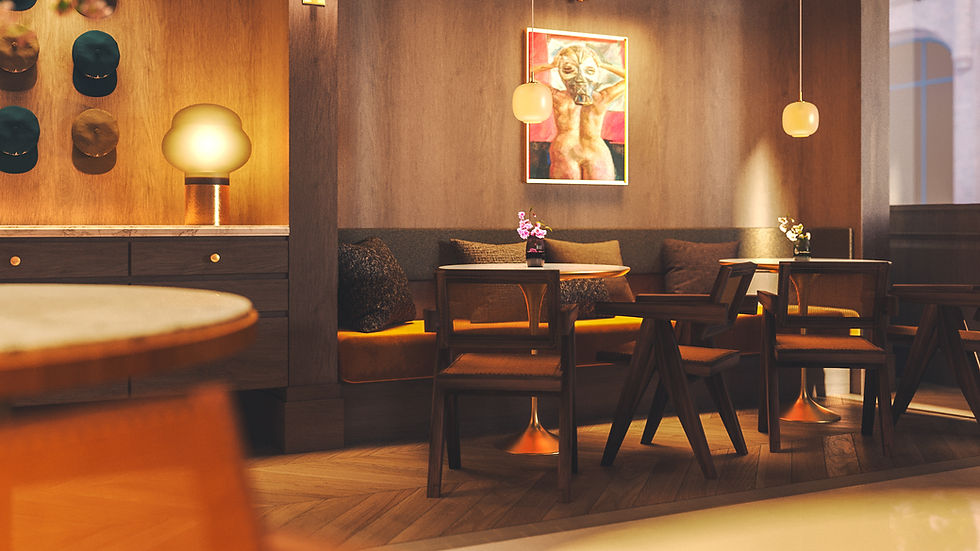
It’s no longer enough to say “3 bedrooms, 2.5 baths.” Buyers want to feel what that means. What does it look like at 6:30 PM when the kids are winding down and someone’s uncorking a bottle of wine? What’s the texture of the walls? The ambient temperature of the lighting? The emotional weather of the room?
Luxury hotels have long understood this alchemy. Walk into an Aman or a Six Senses and you’re not just entering a building — you’re stepping into a curated psychological state. Everything from scent to sound design is choreographed to create a mood.
Why shouldn’t residential real estate do the same?
Enter the Visual Storytellers
This is where advanced architectural visualisation — the kind that blends design fidelity with cinematic emotion — becomes not just helpful, but indispensable.
The best visual artists aren’t just rendering walls and fixtures. They’re crafting emotional microclimates. A living room becomes an invitation to a slower life. A balcony at dusk becomes a symbol of freedom. A kitchen in soft light becomes a promise of connection.
And it works. In a crowded market, these visuals don’t just “help buyers understand the space.” They make them want it. Desperately.
Real Estate Is Lifestyle
The most successful property brands — from Tribeca loft developers to boutique beachfront condominiums in Bahia — know this: you’re not selling property. You’re selling potential.
Potential for a better life.Potential for status, ease, beauty, control, privacy, belonging.
As the lines blur between hospitality, architecture, and luxury branding, the developer's job increasingly resembles that of a storyteller. Or, dare we say, a seducer.
In Conclusion: The Age of Feeling
We are entering an era where emotional design and narrative marketing are not luxuries, but requirements. Where the question isn’t “how many square meters?” but “what does this space feel like to live in?”
So, a final thought:
Are your visuals merely showing the layout — or are they making people fall in love?
If you’re curious how developers around the world are using emotional storytelling to reshape their pre-sales strategy, we invite you to explore the gallery:


Comments